

Pinal County Took Millions Under an Illegal Tax — Residents May Never Get Up to $50 Million Back
A tax approved and implemented by the Board of Supervisors was later struck down by the Arizona Supreme Court. Now tens of millions remain in limbo, and many residents will never see refunds.

Nearly four years after the Arizona Supreme Court ruled that Pinal County’s transportation excise tax was illegal, a new political fight has emerged at the Arizona Legislature: what to do with tens of millions of dollars collected under the unlawful tax, money that came from Pinal County residents and businesses.
While more than $39 million has already been refunded, estimates indicate roughly $40 million to $50 million remains unclaimed, setting the stage for a high-stakes battle over who should control the remaining funds.

A warning ignored — and a lesson for taxpayers
The Goldwater Institute, which represented taxpayers in the lawsuit, says the outcome was avoidable.
“The Goldwater Institute warned the county months before the election that the tax was illegal,” the organization wrote. “But the county ignored that warning, and passed it anyway.”
According to Goldwater, county officials continued collecting the tax even after it was challenged in court and after a judge initially ruled the tax unlawful. The Arizona Department of Revenue also agreed the tax was illegal, yet collections continued while the case moved through the courts.
“Over and over,” Goldwater wrote, “lawyers for the county and the Department of Revenue reassured judges and taxpayers that if the state Supreme Court ultimately declared the tax invalid, taxpayers would get their money back—with interest.”
In April 2022, the Arizona Supreme Court did exactly that, ruling the tax illegal.
The episode serves as a reminder with lasting consequences for Pinal County residents: decisions made by the Board of Supervisors carry enormous weight — and when those decisions are wrong, it is the public that pays the price.
What the Board did wrong according to the Supreme Court
The core failure was structural.
The state Supreme Court found that the excise tax relied on an unlawful two-tier retail structure, taxing only the first $10,000 of a transaction while exempting amounts above that threshold.
Arizona law does not permit that format for transportation excise taxes. Because of that defect, the tax was invalid, yet the county collected tens of millions of dollars under a system it was never legally entitled to use.
While voters approved the concept of a transportation tax, it was the responsibility of the Board of Supervisors to ensure the tax itself complied with state law before it was imposed.
That did not happen.
At the time the tax was referred to the ballot and implemented, the Board consisted of Pete Rios, Mike Goodman, Stephen Q. Miller, Anthony Smith, and Todd House.
Today, Goodman and Miller still serve on the Board.
Although the illegal tax originated under the earlier Board, the current Board has been responsible for managing the fallout, including overseeing the refund process and helping determine what happens to tens of millions of dollars that may never be claimed.
Public statements have been limited from the current Board.
The damage to residents
Between 2018 and 2022, the illegal tax generated approximately $80 million. So far, only a portion has been refunded.
The biggest problem: many residents who ultimately paid the tax will never see their money again.
Arizona’s transaction privilege tax system treats businesses, not consumers, as the taxpayer. That means individual residents who paid higher prices because of the tax are not eligible to claim refunds directly.
Other refunds may never be claimed at all because:
Businesses closed
Owners moved away
Records were lost
Deadlines were missed
As a result, tens of millions may remain in government accounts even after the refund window closes.
The legislative battle over the remaining money
Several bills introduced in the Arizona Legislature would redirect the remaining money toward government-controlled transportation projects rather than returning it directly to taxpayers.
One proposal, HB2273, would distribute remaining funds to a list of transportation projects and public entities within Pinal County.
Another proposal, HB2106, would transfer unclaimed funds to the Arizona Department of Transportation for statewide or regional transportation use.
These proposals have drawn criticism from taxpayer advocates who argue the money should be returned to the people it was taken from, not re-spent by the government.
Representative Teresa Martinez explained the issue as follows:
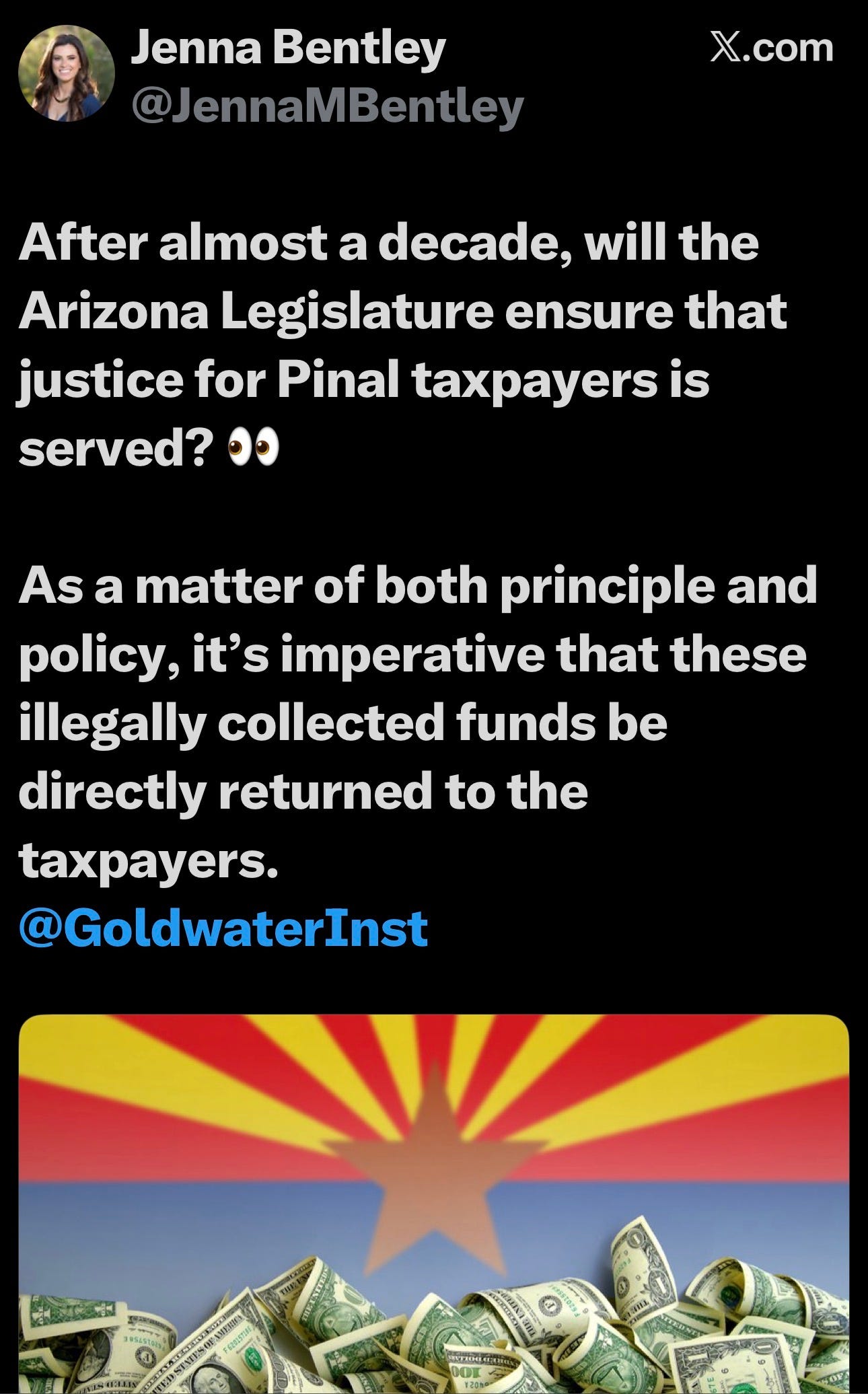
In a post to social media, the Goldwater Institute disagrees and believes the money should be returned to the people.
Local officials have also raised concerns that some communities could receive little or no benefit from the redistribution plans.
The San Tan Valley Town Council voted unanimously Jan. 21 to oppose two Arizona House bills that would determine how roughly $45 million in remaining illegal transportation tax funds are distributed.
Town officials said they were caught off guard to learn that House Bill 2273 does not include a single project in San Tan Valley, despite the community representing about 20% of Pinal County’s population and one-third of its road lane miles.
Mayor Daren Schnepf called the omission “baffling,” noting residents paid into the tax but would receive nothing in return.
A second proposal, House Bill 2106, would route the money through the Arizona Department of Transportation, but town leaders expressed concern that administrative and design costs could reduce the amount spent on actual road construction.
The council voted to oppose both bills unless amended to ensure San Tan Valley receives its share of the remaining funds.

Residents owed may never see their money
Even though the Arizona Supreme Court ruled the tax unlawful in Vangilder v. Arizona Department of Revenue, Arizona’s refund system limits who can actually recover funds.
Under state law:
Businesses—not individual consumers—are considered the legal taxpayers
Refunds must be actively claimed
The deadline to apply is April 9, 2026
This structure creates a harsh reality: many residents who paid higher prices because of the illegal tax will never receive a direct refund.
Once that deadline passes, the Arizona Legislature will decide what happens to any remaining money.
As Goldwater Institute Vice President for Litigation Timothy Sandefur said when the Court struck the tax down, the justices had “rightly put an end to Pinal County’s illegal tax,” and public officials had “repeatedly wasted public money” before demanding more through an unlawful scheme. The Institute called the tax “bizarre” and illegal from the start.
Years later, despite court rulings and public promises, many taxpayers are still waiting.
The bottom line is difficult but clear: the Board of Supervisors isn’t always right—and when government gets it wrong, taxpayers don’t always get their money back.