

Breaking News: Clean Elections Complaint Alleges Myers and Thompson Reused Public Campaign Signs Without Required Payment
After Myers publicly called for accountability over Ralph Heap’s campaign signs, a sworn complaint now puts Myers and Thompson’s own campaign signs under scrutiny.

A new complaint filed with the Arizona Citizens Clean Elections Commission alleges Corporation Commissioner Kevin Thompson and Commissioner Nick Myers reused campaign signs purchased with public funds during their 2022 campaigns without properly purchasing those assets for use in the 2026 election cycle.
The notarized complaint, filed August 13 by Merissa Caldwell, asks the Commission to investigate whether the Thompson and Myers campaigns violated Clean Elections rules governing the reuse of assets purchased during a previous election.
Both Thompson and Myers participated in Arizona’s publicly funded Clean Elections program in 2022 and again during the 2026 Republican primary.
Thompson advanced to the November general election. Myers did not.
The complaint does not establish that either candidate violated campaign finance law. That determination would be up to the Clean Elections Commission following its review.
But the filing points to an unusual paper trail: campaign finance records, photographs of signs being used this year and public statements from Myers and Thompson concerning signs left over from their previous campaigns.
The signs date back to 2022
According to campaign finance records included with the complaint, Myers’ 2022 campaign spent approximately $12,736.63 on campaign yard signs after accounting for refunds, along with another $1,546.36 for rebar used to install signs.
Thompson’s 2022 campaign reported $2,084.77 paid to Mesa Sign Shop and another $60 to Fastsigns, for approximately $2,144.77 in signage.
Those purchases were made during campaigns receiving substantial public funding through Arizona’s Clean Elections system.
The complaint alleges those same signs were preserved after the 2022 election and ultimately returned to Arizona streets during the 2026 campaign.
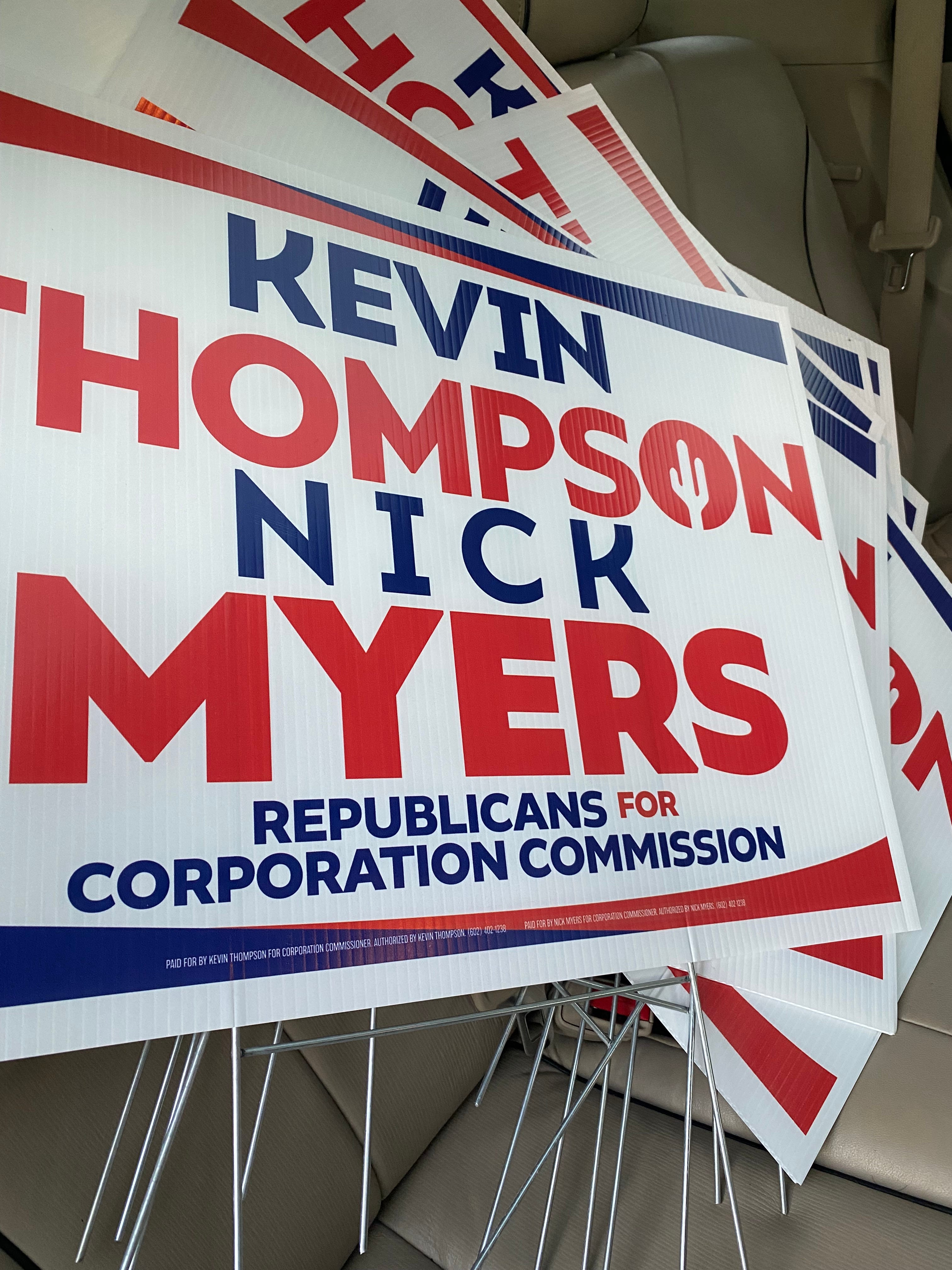
And one of the strongest pieces of evidence cited by the complainant comes from Myers himself.
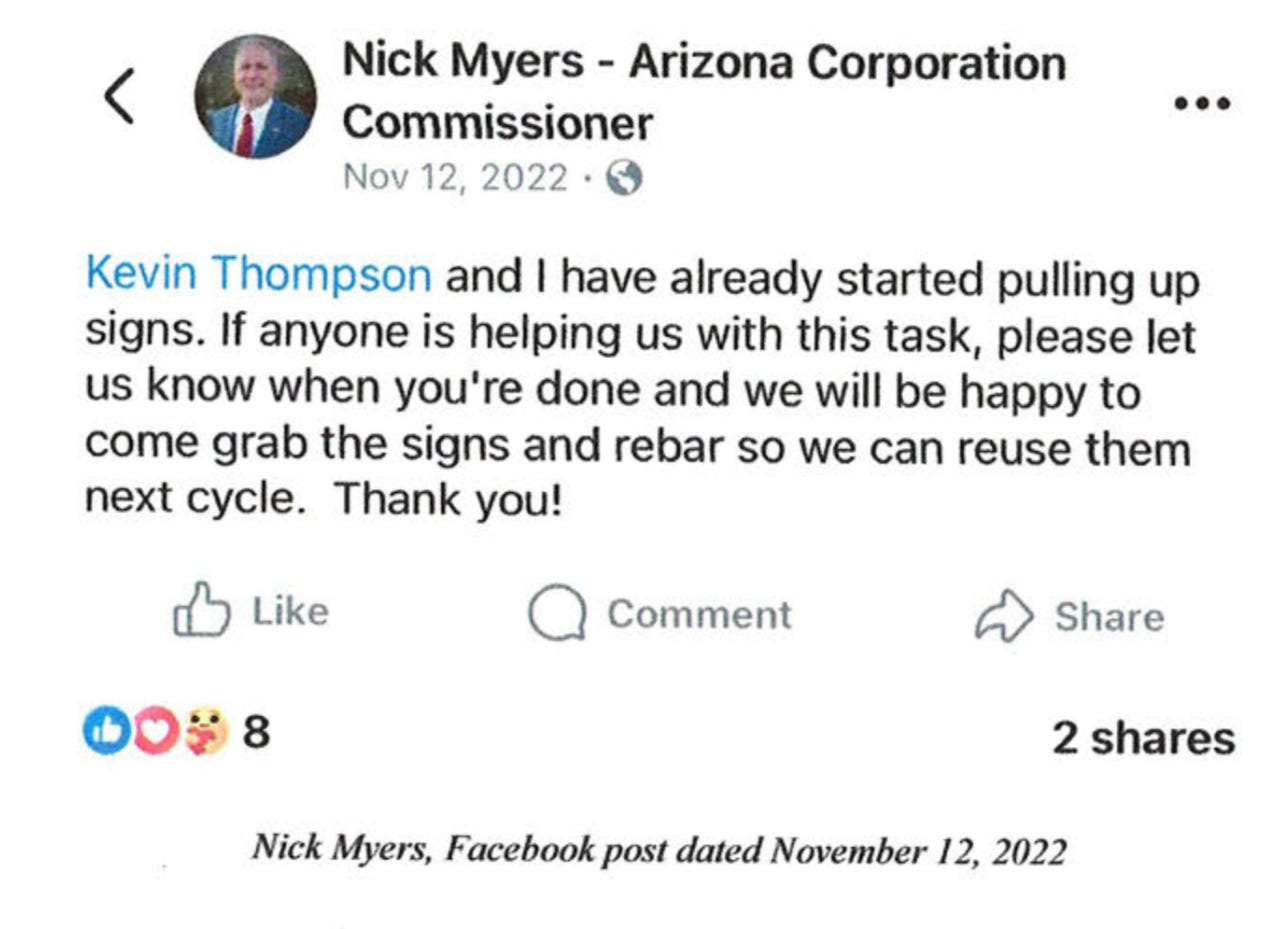
On November 12, 2022, Myers posted on Facebook:
“Kevin Thompson and I have already started pulling up signs. If anyone is helping us with this task, please let us know when you’re done and we will be happy to come grab the signs and rebar so we can reuse them next cycle. Thank you!”
A screenshot of that post is included as Exhibit A of the complaint.
Four years later, signs bearing the names of Thompson and Myers began appearing again.
The complaint includes a May 11 post from Thompson showing a Thompson/Myers sign and asking supporters to volunteer to install signs.
“Signs are going up,” Thompson wrote. “If you’d like to volunteer to help us install some, DM either myself or @votenickmyers. We’d appreciate any help!”
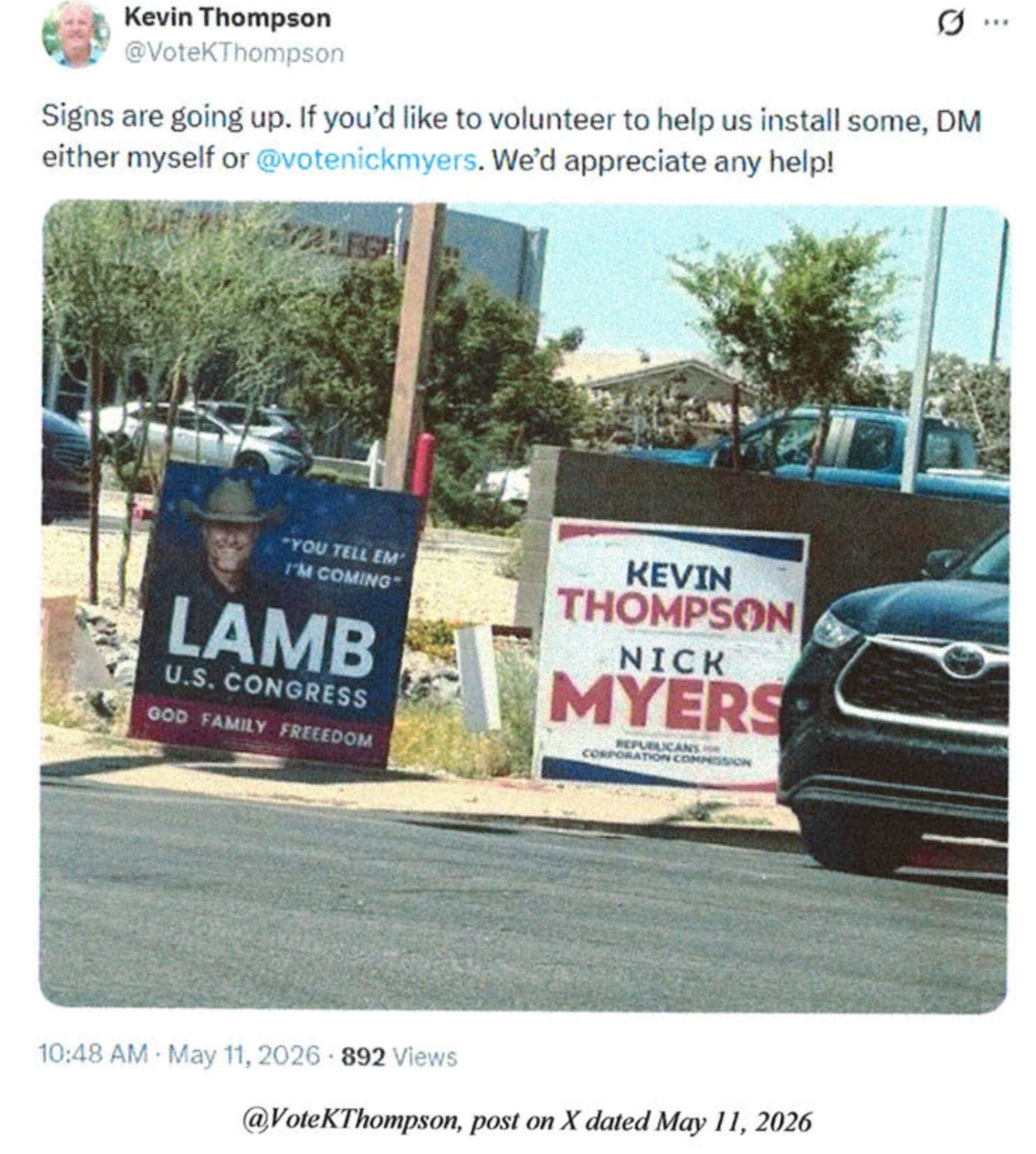
Additional posts from May 27 and June 3 show Thompson thanking supporters displaying Thompson/Myers campaign signs at their homes.
Myers: “We did not buy any signs this cycle”
The dispute became more significant in August when questions surfaced about where the signs came from.
According to an X post included in the complaint, a social media user said she had spoken with Myers about the signs and wrote:
“I talked to him about this and the signs that were put up were done so by volunteers that kept them from the last time they ran. As far as they were concerned the signs were ‘junk’ and they never bought any this time. That’s why you don’t see any on their finance report.”
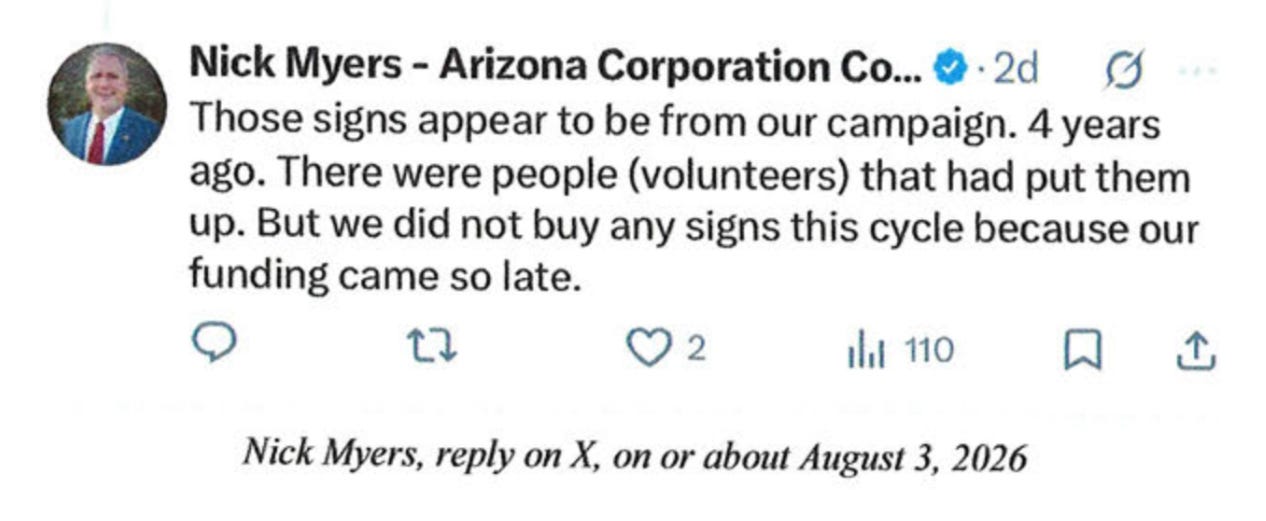
Myers then responded publicly himself.
“Those signs appear to be from our campaign. 4 years ago. There were people (volunteers) that had put them up. But we did not buy any signs this cycle because our funding came so late.”
That statement is now central to the complaint.
The complainant argues that the issue is not simply whether the campaigns spent money printing new signs in 2026. The issue is whether signs originally purchased using Clean Elections money in 2022 became assets of the prior campaign that had to be purchased before they could be used by a new publicly funded campaign.
The Clean Elections rule
The complaint cites Arizona Administrative Code R2-20-702.01, governing the use of assets from a prior election.
According to the rule as quoted in the complaint, a participating candidate may use assets from a previous election cycle only after the current campaign committee purchases those assets from the previous campaign committee.
The purchase must be for fair market value, subject to a floor of at least one-fifth of the asset’s original purchase price.
And when the candidate participated in Clean Elections during the previous cycle, the complaint states that payment for those assets is made to the Commission.
That distinction could matter.
This is not simply a dispute over candidates recycling old political signs instead of throwing them away. The allegation is that assets originally acquired through taxpayer-funded campaigns were subsequently used by new taxpayer-funded campaigns without the transaction required under Clean Elections rules.
The complainant calculates that applying the one-fifth minimum to the reported 2022 expenditures would result in a required payment of roughly $2,856.60 for Myers’ signs and rebar and approximately $428.95 for Thompson’s signage, before accounting for any allocation involving jointly used rebar.
The complaint says it found no corresponding payment in either campaign’s finance reports.
Campaign finance records included
The filing attaches screenshots from the Arizona Secretary of State’s See the Money campaign finance database.
For Myers, the records show the 2022 payments to BP Graphics and CMC Rebar. Another exhibit shows Clean Elections funding received by the Myers campaign, including $110,698 in June 2022, $166,047 in August 2022 and $147,836 on July 11, 2026.
For Thompson, the attached records show the 2022 signage expenditures and a $147,836 Clean Elections funding payment on July 8, 2026. The final exhibit shows that payment but no additional Clean Elections transaction corresponding to the alleged purchase of the old signs.
The complaint says Myers’ campaign finance records contain no transaction referencing signs or rebar during the 2026 cycle and no payment to the Commission other than public-funding disbursements.
It alleges the same basic pattern for Thompson.
The filing acknowledges a $20.70 payment from Thompson’s 2022 campaign to the Commission on November 8, 2022, but argues that amount is far below what would represent the purchase of campaign assets costing more than $2,100.
Complaint also raises campaign certifications
The complaint goes beyond the signs themselves.
Caldwell is asking the Commission to examine certifications made by both campaigns in connection with receiving Clean Elections money.
Under the rules cited in the filing, participating candidates certify compliance with the Clean Elections Act and Commission rules and certify that campaign finance reports are complete and accurate before receiving public funding.
Myers received $147,836 in Clean Elections funding on July 11.
Thompson received $147,836 on July 8.
The complaint argues that if either campaign was already using 2022 assets without making the required purchase, the Commission should determine whether the certifications submitted before those public funds were released were accurate.
Caldwell signed a sworn statement declaring under penalty of perjury that the factual assertions in the complaint were true and correct based on her personal knowledge, except for matters expressly stated upon information and belief. The statement was notarized August 13 in Maricopa County.
Commission asked to investigate
Caldwell is asking Clean Elections to investigate whether the campaigns used 2022 signs and rebar without purchasing them as required, determine the fair market value of those assets, require payment to the Commission if necessary and examine whether the campaigns’ certifications were accurate.
She also asks the Commission to take any additional action it considers appropriate under the Citizens Clean Elections Act and its rules.
The complaint arrives as campaign-sign spending has already become a contentious issue in the Corporation Commission race.
Earlier this month, Myers publicly urged Clean Elections commissioners to take action against Republican Corporation Commission nominee Ralph Heap amid separate allegations concerning Heap’s campaign-sign expenditures.
The Commission’s independent legal adviser made clear during that proceeding that allegations of misconduct and potential sanctions against Heap were not before commissioners at that hearing. The Commission ultimately voted 4-0 to deny Heap’s request to withdraw from the Clean Elections program.
Now, Myers and Thompson face a separate complaint involving campaign signs of their own.
Filing a complaint is not a finding of wrongdoing. The allegations against Myers and Thompson remain allegations unless and until Clean Elections investigates and makes a determination.
But the records attached to the complaint create a straightforward question for the Commission:
If publicly funded signs purchased in 2022 were deliberately saved to “reuse them next cycle,” and those signs were then used in the 2026 campaign, did the campaigns follow the Clean Elections rules required to transfer those publicly financed assets into their new campaigns?
That is now a question for Clean Elections to answer.
In Case You Missed It: The Arizona Globe previously covered the Clean Elections hearing involving Ralph Heap. Read that coverage here.
Editor’s Note: State 48 News recognizes that Ralph Heap, Nick Myers and Kevin Thompson are entitled to due process. Allegations or complaints referenced in our reporting should not be construed as findings of wrongdoing unless and until established through the appropriate legal or administrative process.